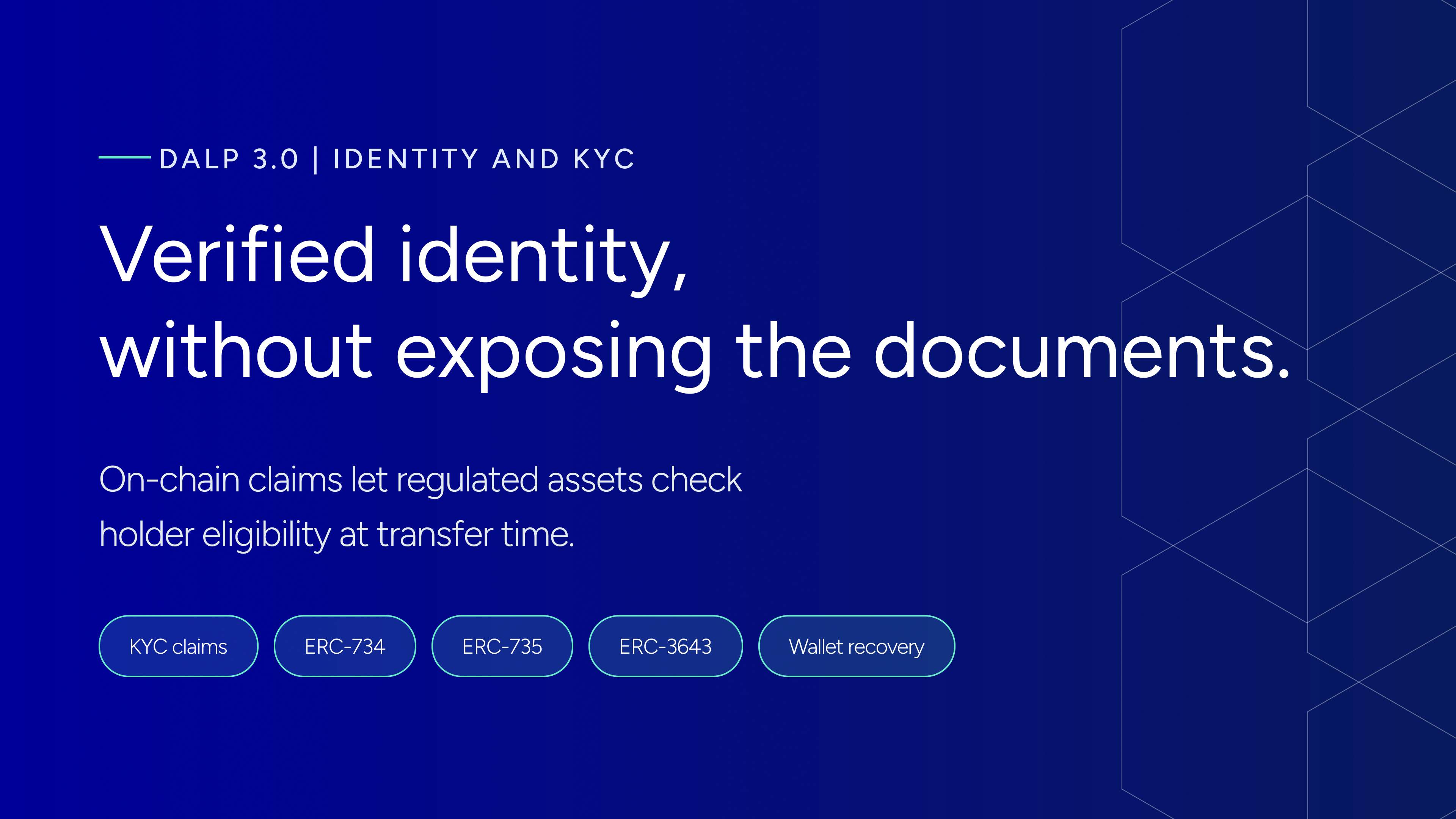
A regulated digital asset needs to confirm that every holder is permitted to hold it. That confirmation has to happen without pulling passports, address documents, accreditation files or other personal records into the asset layer.
DALP 3.0 uses a claims-based identity model for that purpose. A trusted provider verifies a participant and records the result as an on-chain identity claim. The asset checks the claim at transfer time and acts on the result, while the underlying documents remain outside the asset layer.
For regulated institutions, that separation is important. Sensitive documents stay with the verification provider or controlled application layer, while the asset receives the information it needs to enforce eligibility, compliance and transfer rules.
Identity claims are what the asset checks
In DALP 3.0, participant verification is expressed through typed claims. A claim can represent KYC clearance, AML screening, accreditation, jurisdiction eligibility or another compliance topic defined by the institution.
The participant record brings account details, wallets, claims, verification topics and onboarding status into one surface. Reviewers can see the full participant lifecycle in context, from intake and monitoring to versioned history and recovery.
The product design is described in the DALP 3.0 identity and KYC documentation.
Documents stay away from the asset layer
The asset does not need to see the document used to support a verification. It needs to know whether a trusted issuer has signed a valid claim for a specific participant, topic and point in time.
This claims-not-documents model reduces the amount of sensitive personal data exposed to the asset layer. The documents backing a claim can remain under the control of the verification provider or protected application storage, while the on-chain compliance layer reads the signed attestation.
For banks, asset managers, market infrastructure providers and public-sector institutions, that separation supports a cleaner data-protection model. Personal records are kept away from execution logic, and the asset still has a reliable basis for enforcing holder eligibility.
Built on open on-chain identity standards
DALP's identity model is grounded in open Ethereum standards. ERC-734 defines an on-chain key holder, where keys can be assigned purposes such as management, execution or claim signing. ERC-735 defines an on-chain claim holder, where typed claims are stored and verified.
ERC-3643 connects that identity model to regulated asset transfers. Before a transfer settles, the token checks whether the participant has a verified identity and whether the required claim topics are present from authorized issuers.
DALP implements these interfaces and extends them with issuer configuration. Institutions can define global issuers trusted across a deployment and per-token overrides for assets with their own compliance perimeter. The standards-based model is explained in the documentation section on open on-chain identity standards.
Point-in-time history for audit and compliance
A current verification status is only part of the record. Compliance and audit teams also need to know what was true when a transfer happened.
DALP 3.0 keeps a versioned history for KYC profiles. Each review, verdict change and data update is recorded with a timestamp, giving reviewers and auditors a view of what was on file at a specific point in time.
Uploaded documents receive application-layer encryption at rest. The evidence behind a claim is protected independently of the storage infrastructure, while the claim remains available for transfer checks and audit review.
Participant recovery stays inside the lifecycle
Participant identity includes recovery. When a participant loses access to a wallet, DALP provides a dedicated in-platform recovery path that preserves the ownership record and produces an audit trail for the event.
DALP 3.0 also supports recovery of an organization identity that has been squatted on-chain. The platform can deploy a legitimate replacement bound to the organization's recovery salt and re-link it atomically in one transaction, so downstream consumers see the corrected record immediately.
Those flows are covered in the documentation sections on wallet recovery and organization identity recovery.
No re-verification for existing records
DALP 3.0 brings existing KYC records and identity claims into the unified identity surface without requiring participants to be re-verified. Records created before the upgrade remain visible in the versioned history view.
That continuity matters for institutions operating live programs. The identity surface becomes more complete without forcing a new onboarding cycle for participants already known to the platform.
The migration behavior is noted in the documentation section on existing KYC records and identity claims.
Identity as part of a financial product
Identity is one part of the wider DALP 3.0 operating model. A regulated asset also depends on lifecycle features such as fees, yield, redemption and trusted price data. DALP 3.0 brings those capabilities into the same platform context, so the asset can behave like a financial product rather than a standalone token.
The identity layer gives that product a controlled participant surface. The asset checks verified eligibility at transfer time, the institution keeps sensitive documents away from the asset layer, and the participant lifecycle remains visible to compliance and operations teams.
To see how identity and KYC fit into the wider release, visit the DALP platform overview or read the DALP 3.0 identity and KYC documentation.
Frequently asked questions
DALP 3.0 maps verification results from trusted providers into on-chain identity claims. The asset checks those claims at transfer time to confirm that the participant is eligible.
No. The asset checks a signed claim, not the underlying document. Sensitive documents remain outside the asset layer and can be protected through the verification provider or application-layer storage.
DALP 3.0 uses open on-chain identity standards including ERC-734 for key management, ERC-735 for claims, and ERC-3643 for regulated asset transfer checks.
Yes. DALP 3.0 keeps versioned KYC history, including reviews, verdict changes and data updates with timestamps, so reviewers and auditors can inspect the record at a specific point in time.
No. Existing KYC records and identity claims carry forward into the unified identity surface without re-verification.
Want to discuss how reusable compliance policy fits your digital asset program?
Book a call with our team ↗
About SettleMint
SettleMint, headquartered in Leuven, Belgium, with offices in UAE, Singapore and Japan is the company behind DALP, the Digital Asset Lifecycle Platform. DALP enables financial institutions, market infrastructure operators, and governments to build, deploy, and manage digital assets and blockchain applications at scale.