6-minute platform walkthrough
See DALP in action
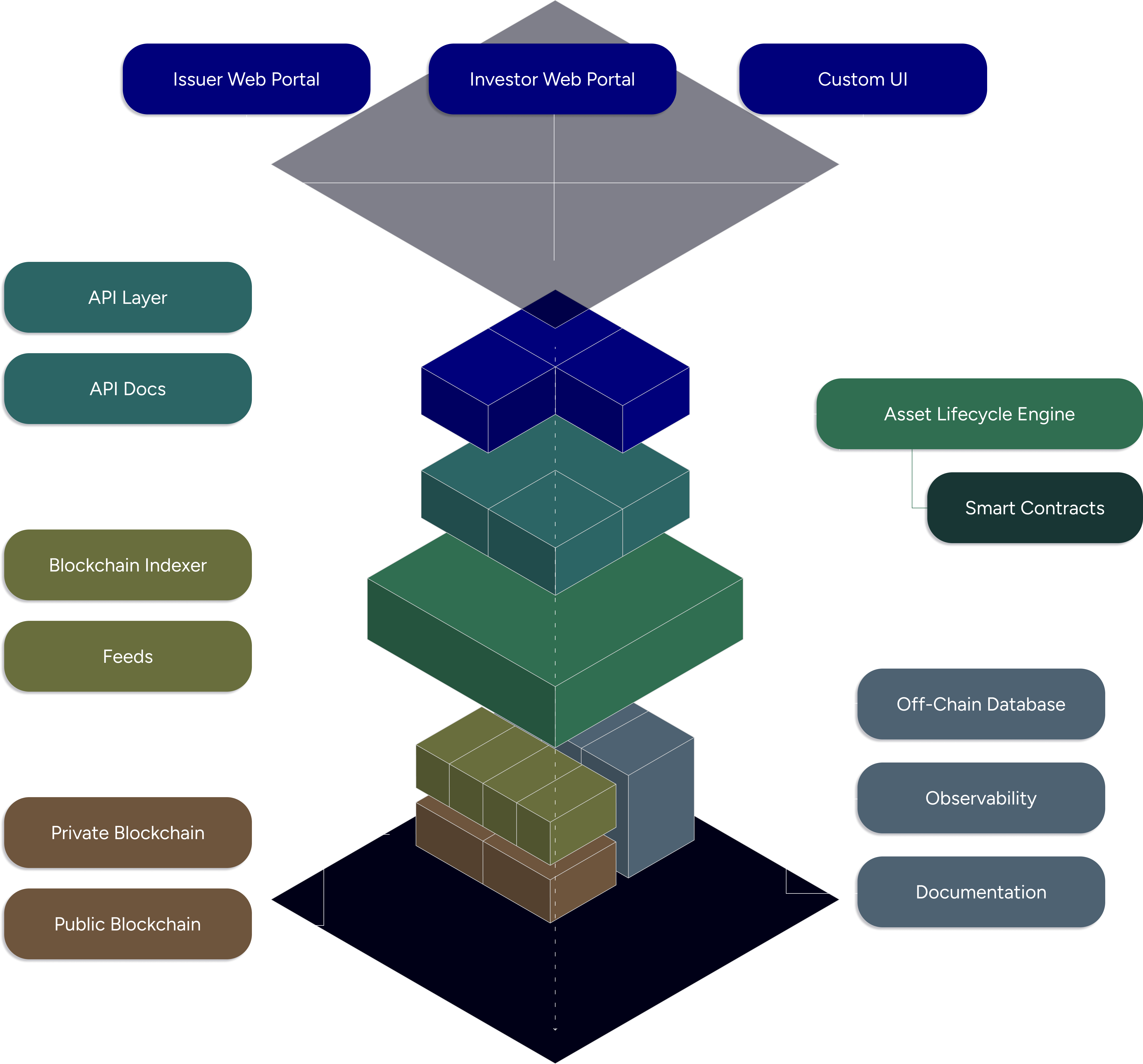
In this demo, SettleMint CTO and Co-Founder, Roderik van der Veer, walks through our Digital Asset Lifecycle Platform and the infrastructure behind it. Roderik covers the core building blocks needed to manage digital assets across their lifecycle: asset configuration, participant roles, compliance workflows, issuance, servicing, settlement, reporting, and operational controls.
How DALP fits
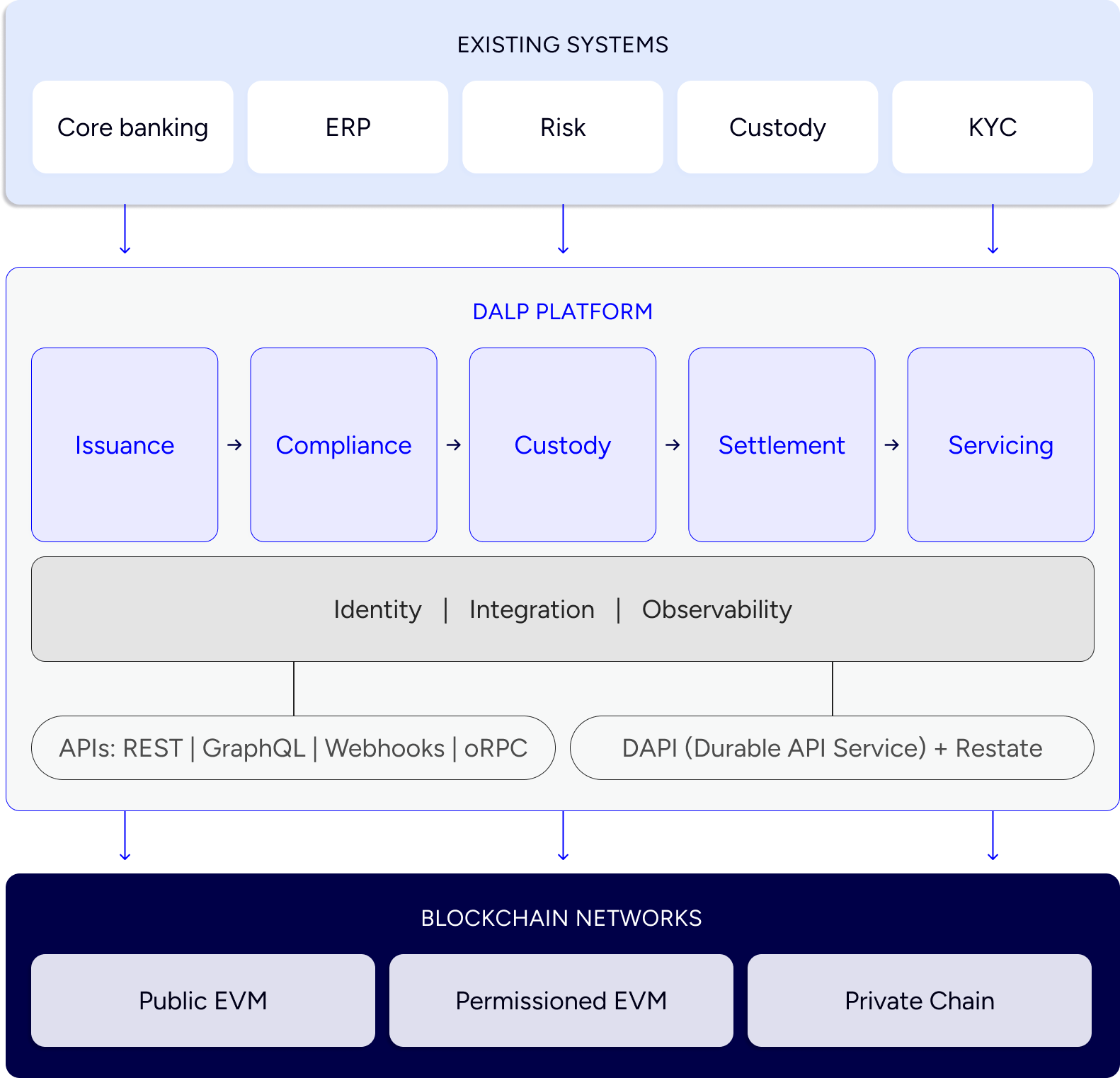
DALP sits between your existing core systems and blockchain networks, providing the governance, orchestration, and lifecycle management layer that neither side delivers alone.

Above DALP
Your existing infrastructure stays in place. Core banking, ERPs, risk engines, custody providers, and KYC systems connect through standard APIs. No rip-and-replace.
DALP layer
Five pillars (Issuance, Compliance, Custody, Settlement, Servicing) on three foundations (Identity, Integration, Observability). Platform API service layer with durable execution orchestrates all of it.
Below DALP
Any EVM-compatible blockchain network: public, permissioned, or private. DALP abstracts chain complexity so business teams operate on asset and workflow concepts, not protocols.
platform foundations
3 foundations that underpin every pillar
OnchainID provides verifiable, on-chain investor identities. The Identity Registry manages verified profiles with claim-based verification — KYC/KYB credentials, accreditation status, jurisdictional eligibility — reusable across all assets and transactions. Onboard an investor once; credentials apply everywhere.
Role-Based Access Control with 5 defined roles governs every action, from token issuance to transfer approval. No transfer, no settlement, no corporate action executes without verified identity. This is the trust layer for the entire platform.
REST, GraphQL, event webhooks, oRPC — programmatic access to every platform capability.
- Configurable settlement infrastructure for institutional payment workflows
- Bring-your-own-custodian (Fireblocks, DFNS)
- Bring-your-own-chain (any EVM network)
- Cloud, on-prem, or managed SaaS
DALP operates within your existing environment. No vendor replacement required.
Production-grade operational tooling — not just smart contracts.
-
Pre-built Grafana dashboards: operations, transactions, compliance, security events
-
Three-pillar observability: metrics (Victoria-Metrics), logs (Loki), traces (Tempo)
-
Automated alerting on error spikes, latency, and chain connectivity
-
SIEM-ready audit logging
-
Durable execution — workflows survive process restarts and infrastructure failures
Identity & Access Management
OnchainID provides verifiable, on-chain investor identities. The Identity Registry manages verified profiles with claim-based verification — KYC/KYB credentials, accreditation status, jurisdictional eligibility — reusable across all assets and transactions. Onboard an investor once; credentials apply everywhere.
Role-Based Access Control with 5 defined roles governs every action, from token issuance to transfer approval. No transfer, no settlement, no corporate action executes without verified identity. This is the trust layer for the entire platform.
Integration & Interoperability
REST, GraphQL, event webhooks, oRPC — programmatic access to every platform capability.
-
Configurable settlement infrastructure for institutional payment workflows
-
Bring-your-own-custodian (Fireblocks, DFNS, HSM, and local signing)
-
Bring-your-own-chain (any EVM network)
- Cloud, on-prem, or managed SaaS
DALP operates within your existing environment. No vendor replacement required.
Observability & Operations
Production-grade operational tooling — not just smart contracts.
-
Pre-built Grafana dashboards: operations, transactions, compliance, security events
-
Three-pillar observability: metrics (Victoria-Metrics), logs (Loki), traces (Tempo)
-
Automated alerting on error spikes, latency, and chain connectivity
-
SIEM-ready audit logging
-
Durable execution — workflows survive process restarts and infrastructure failures
deployment flexibility
Deploy on your own terms
Any EVM-compatible network — public or permissioned. Multi-chain support for institutions operating across networks. No vendor lock-in. No forced infrastructure decisions.
Cloud
Managed SaaS or bring-your-own-cloud — DALP runs on the provider and region you choose.
On-Prem
Helm/Kubernetes deployment in your data center, under your operational control. Full air-gapped support for environments with strict data residency requirements.
Hybrid
Split workloads across cloud and on-prem environments to meet data residency, regulatory, and security constraints — with a consistent operating model across both.