Why tokenization programs stall
Custom smart contract development is the wrong bottleneck
Institutions launching tokenization programs face a recurring pattern: every new asset class requires custom smart contract development, security audits, and months of integration work. The result is slow time-to-market, high cost, and instruments that lack the lifecycle logic financial operations demand.
Generic token platforms deploy ERC-20 tokens, not financial instruments. They lack coupon schedules, data feed integration, maturity handling, and the compliance controls regulators require. The gap between "token deployed" and "instrument operational" is where most programs stall.

Months of Custom Development
Every new instrument means a new smart contract engagement. Security audits, testing cycles, and deployment delays turn weeks into quarters.
Generic Tokens, No Lifecycle Logic
Most platforms deploy ERC-20 tokens with no embedded financial logic. No coupon schedules, no pricing integration, no maturity handling. You get a token, not a financial instrument.
Integration Afterthought
Core banking, ERPs, and governance systems are connected after the fact, not by design. Every integration is custom, fragile, and a maintenance liability.
how dalp solves it
Purpose-built templates, not generic tokens
SettleMint cto and co-founder: roderik van der veer
6-minute platform walkthrough
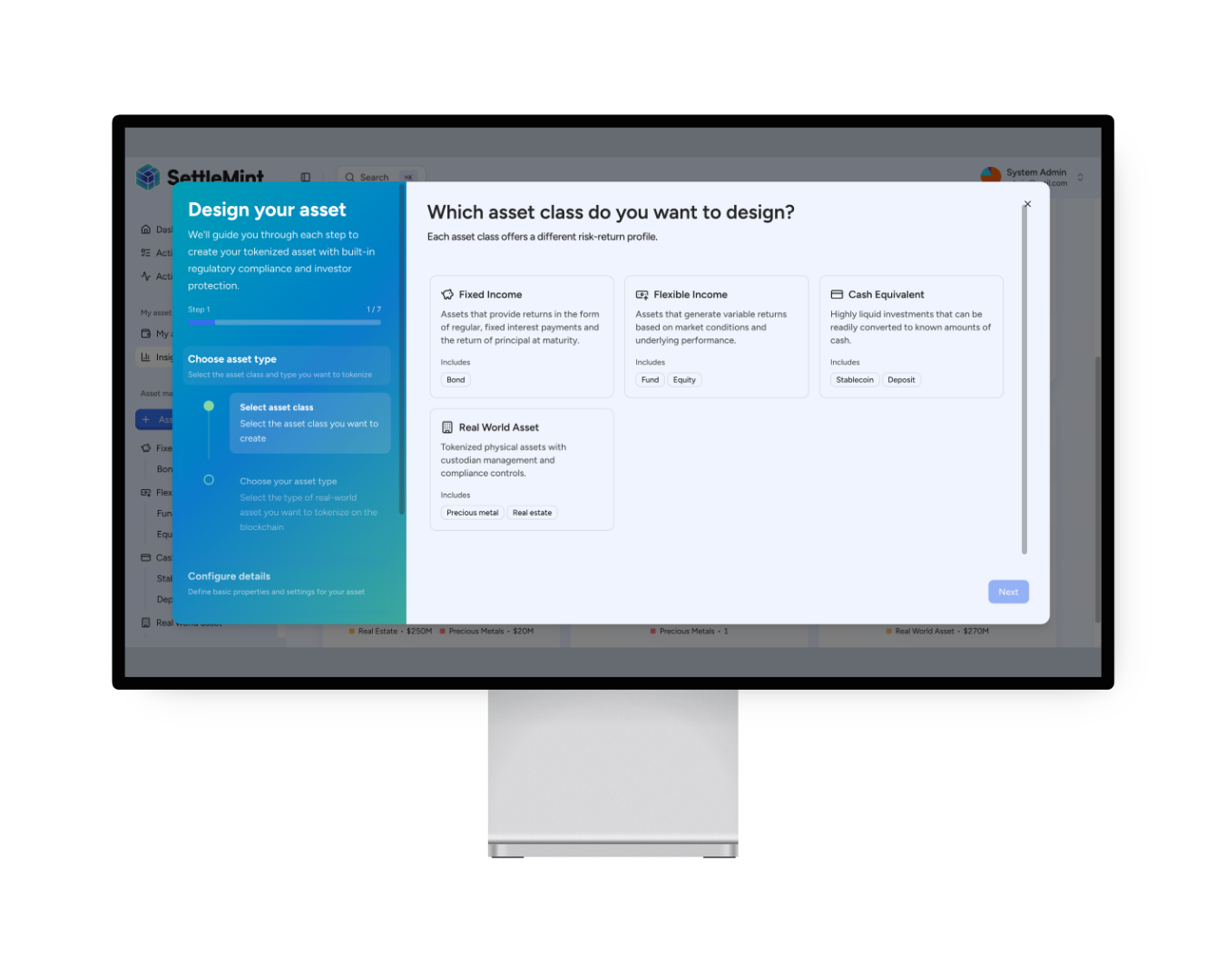
In this demo, Roderik walks through our Digital Asset Lifecycle Platform and the infrastructure behind it. Roderik covers the core building blocks needed to manage digital assets across their lifecycle: asset configuration, participant roles, compliance workflows, issuance, servicing, settlement, reporting, and operational controls.
digitize any asset class
Composable digital assets: beyond the 7 templates
The composable digital asset extends DALP beyond its seven pre-built templates. A composable, feature-rich architecture with dynamic runtime capabilities supports up to 32 pluggable features per token, added or reordered post-deployment without redeploying the token itself.

11 pre-built feature types available out of the box: AUM fees, conversion, external transaction fees, fixed treasury yield, historical balances, maturity redemption, EIP-2612 permits, transaction fees, transaction fee accounting, and voting power.
Ordered execution pipeline where features execute in a defined sequence, giving issuers precise control over token behavior.
Same ERC-3643 compliance, RBAC governance, and custody controls as every other DALP asset. New asset types deployed in hours, not weeks.
Multi-chain deployment
DALP's issuance orchestration uses a discriminated-union schema — each supported asset class has dedicated validation semantics, class-specific factory dispatch, and claim enrichment. Bond issuance includes additional compliance behavior. Equity uses a different constructor contract. Fund issuance carries management fee parameters.
This isn't generic token minting. It's deterministic, class-aware asset provisioning with lifecycle identifiers, tenant boundaries, and operational metadata, deployed to any EVM-compatible network.
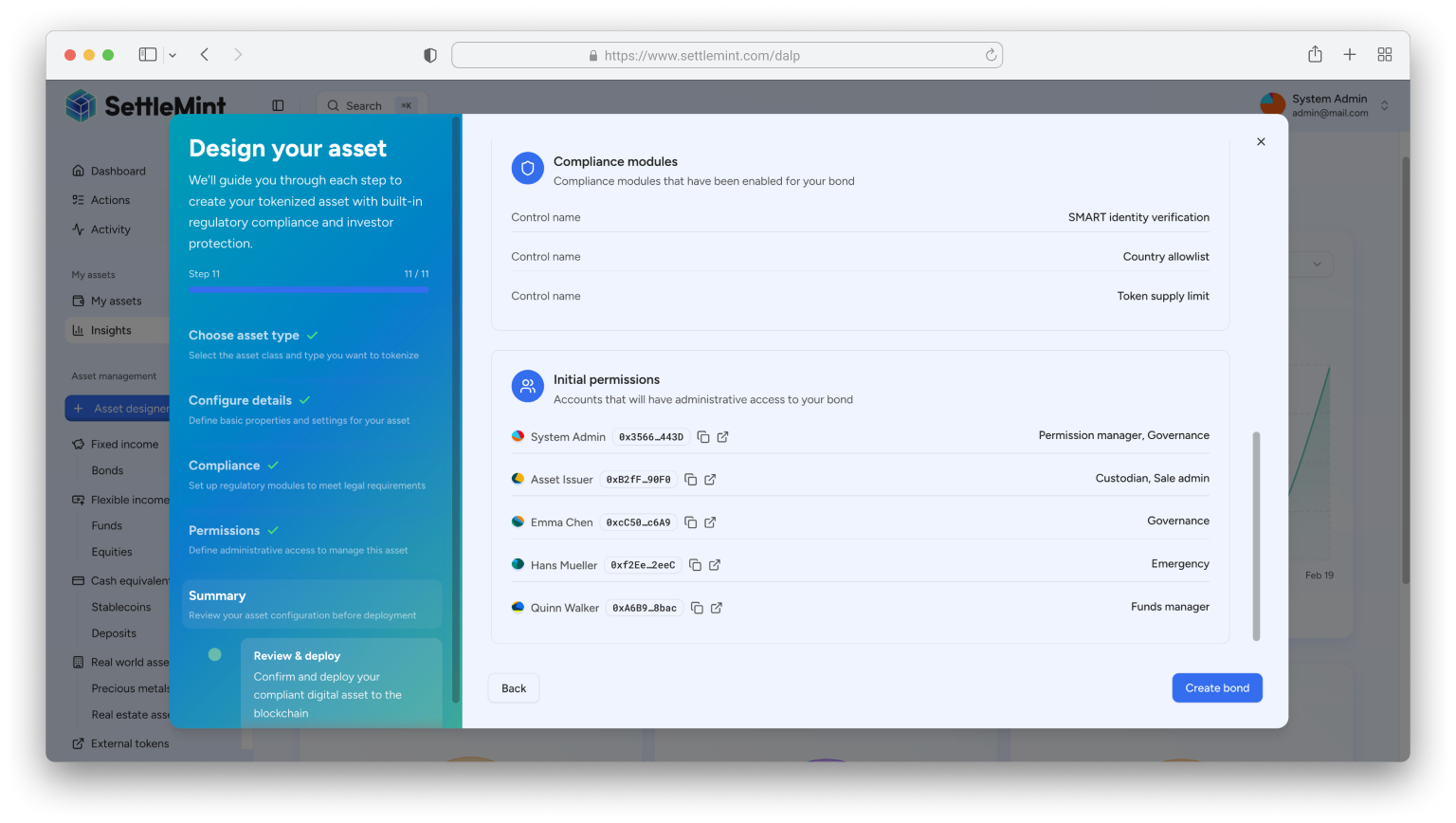
Public or permissioned EVM chains. Deploy where your regulatory and business needs dictate.
Class-specific validation, factory dispatch, and claim enrichment per asset class.
Everything you need to issue
Key capabilities
Seven asset classes. One unified workflow. Every template comes pre-wired with its own business rules, compliance controls, and identity layer, so you configure terms, schedules, and fee structures at issuance, not in a backlog. Need something outside the seven? The composable digital asset handles any asset type you throw at it. No Solidity. No custom development. Just structured, compliant issuance from day one.

Asset Classes
7 pre-built templates + composable digital asset for any asset type
Business Rules
Terms, schedules, maturity logic, and fee structures configured at issuance
Compliance Integration
ERC-3643 compliance controls and OnchainID identity embedded at deployment
Smart Contract Generation
No custom development — templates with class-specific validation and factory dispatch
Multi-Chain
Any EVM-compatible network, public or permissioned
APIs & Deployment
REST, GraphQL, event webhooks, and oRPC access, deployed to cloud, on-prem, or managed SaaS