In October 2025 at Token2049, Robinhood CEO Vlad Tenev told his audience that tokenization was "like a freight train" that would "eat the entire financial system." Recent market activity has reinforced that view:
-
BlackRock's BUIDL treasury tokenization fund, launched in March 2024, now has $2.5 billion in assets under management.
-
J.P. Morgan has scaled its Onyx platform (now Kinexys) to process more than $2 billion in average daily transaction volume.
-
State Street launched its Digital Asset Platform (DAP) in January 2026 to develop tokenized money market funds, ETFs, and cash products, including tokenized deposits.
-
The New York Stock Exchange announced in January 2026 that it is building a tokenized securities platform offering 24/7 trading, instant settlement, and stablecoin-based funding for U.S. equities and ETFs.
Tokenized real-world assets are expected to double in 2026, reaching $80 billion, up from $37 billion in 2025. Deutsche Bank projects tokenized real-world assets (excluding stablecoins) to reach $1.5–2 trillion by 20307, expecting tokenized capital markets to become the default infrastructure for issuance and trading.
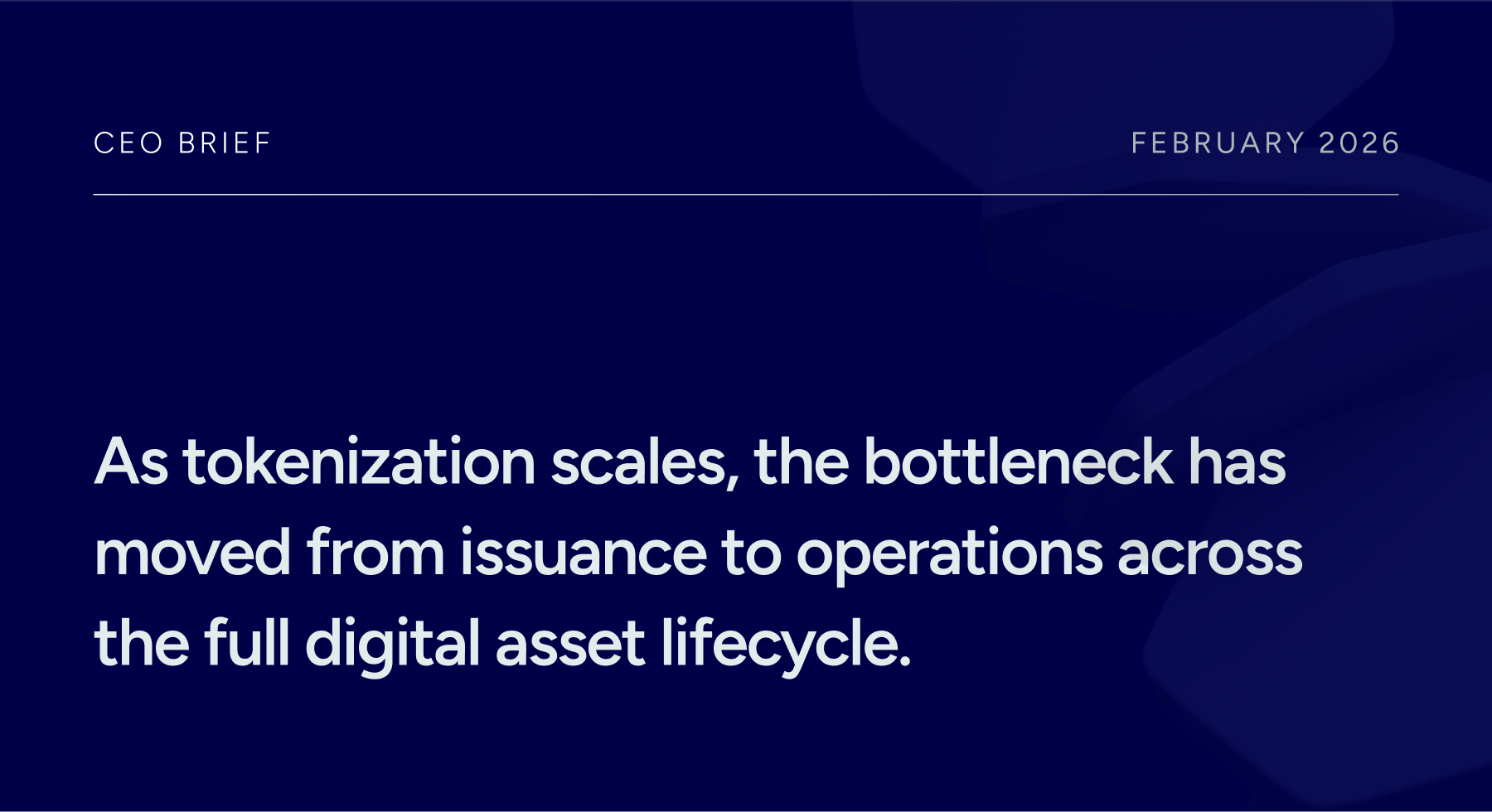
As tokenization scales, the bottleneck has shifted from issuance to operations, managing compliance, custody, settlement, and servicing across the full digital asset lifecycle.
SettleMint's Digital Asset Lifecycle Platform (DALP) was built for this moment.
Structured around three core capabilities (digital asset lifecycle management, ecosystem integration and compliance) and backed by a decade of enterprise blockchain infrastructure, DALP delivers unified lifecycle management with the flexibility and simplicity that only come from deep, full-stack technology, not bolted-on point solutions.
The bottleneck has shifted
The first generation of tokenization platforms were mainly built to address the first part of the value chain: issuance. Most were not designed to solve, and still cannot, everything that comes after. Institutions now face a very different operational reality:
-
Managing cap tables across thousands of token holders
-
Executing corporate actions (dividends, splits, redemptions) with full auditability
-
Supporting secondary trading with settlement finality
-
Enforcing compliance before every transfer executed
-
Managing custody workflows with enterprise-grade controls across multiple networks
The reason most platforms cannot address this reality is architectural. They were purpose-built for token creation and bolted on lifecycle functions as afterthoughts. The result is fragmented stacks where compliance sits in one system, custody in another, corporate actions require manual intervention, and there is no unified control plane governing the asset from mint to redemption.
This is not a feature gap. It is a structural limitation. Tokenized markets cannot scale on loosely coupled point solutions where every post-issuance operation requires custom integration, manual reconciliation, or third-party workarounds.
SettleMint's Digital Asset Lifecycle Platform
A decade of institutional deployment at SettleMint created a full-stack infrastructure layer spanning network management, smart contract development, middleware, key management, and enterprise integration. That foundation was built with two principles:
-
Flexibility: deployable across any EVM network, on-premises or cloud, without vendor lock-in.
-
Simplicity: turning what typically takes months of blockchain development into weeks.
As the market evolved, SettleMint used this foundation to launch DALP. Where competitors started with tokenization and are now trying to bolt on infrastructure, SettleMint built the infrastructure first and extended it into complete digital asset lifecycle management. That architectural depth is why DALP can operate as a unified control plane where point solutions cannot.
DALP is the operational backbone for regulated digital asset markets, supporting assets from issuance through compliance, custody, settlement, servicing, and retirement under a single governance and control framework. It is structured around three core capabilities:
-
Lifecycle Management: Keeps ownership, compliance state, custody rules, and governance continuously synchronized from issuance through corporate actions, settlement, and secondary markets, eliminating the reconciliation overhead that emerges when these responsibilities are fragmented across disconnected systems.
-
Ecosystem Integration: Orchestration layer between core financial infrastructure and blockchain networks, integrating with custody providers, core banking systems, payment rails, and trading venues. Deploys across public or private EVM networks, on-premises or SaaS, without replacing existing systems.
-
Compliance by Design: Compliance enforced before execution, not after. Every transfer validated against eligibility rules and jurisdictional constraints before it occurs, preventing non-compliant transfers from ever being recorded on-chain. 18 distinct compliance module types, combinable through logical expressions and reusable across assets and jurisdictions.
An important note on custody: DALP integrates custody as a cross-cutting capability rather than a standalone module. Custody rules are enforced throughout the asset lifecycle (from issuance through transfers and corporate actions) while the ecosystem layer connects to institutional custody providers, qualified custodians, and self-custody wallets through standardized, provider-agnostic interfaces. Compliance checks validate custodial eligibility before any transaction executes on-chain, ensuring custody is continuously governed alongside the asset rather than bolted on separately.
Looking ahead
DALP was deliberately built not as a blockchain network, a custody provider, an exchange, or a developer toolkit. DALP is the orchestration and operations layer that sits between an institution's existing infrastructure and blockchain networks, integrating with custodians, trading venues, and compliance providers rather than replacing them. This architectural positioning is intentional: it allows institutions to adopt DALP without disrupting existing vendor relationships or rebuilding their technology stack.
As digital assets move deeper into core financial architecture, operational excellence will define the winners. Platforms capable of supporting regulated, high-volume, multi-asset operations will become foundational market infrastructure.
DALP is SettleMint's answer to this moment: a unified platform purpose-built for the lifecycle operations that have become the industry's defining constraint.
The question for institutions is no longer whether to tokenize. It's whether their infrastructure can manage what comes after.
Adam Popat
Chief Executive Officer, SettleMint