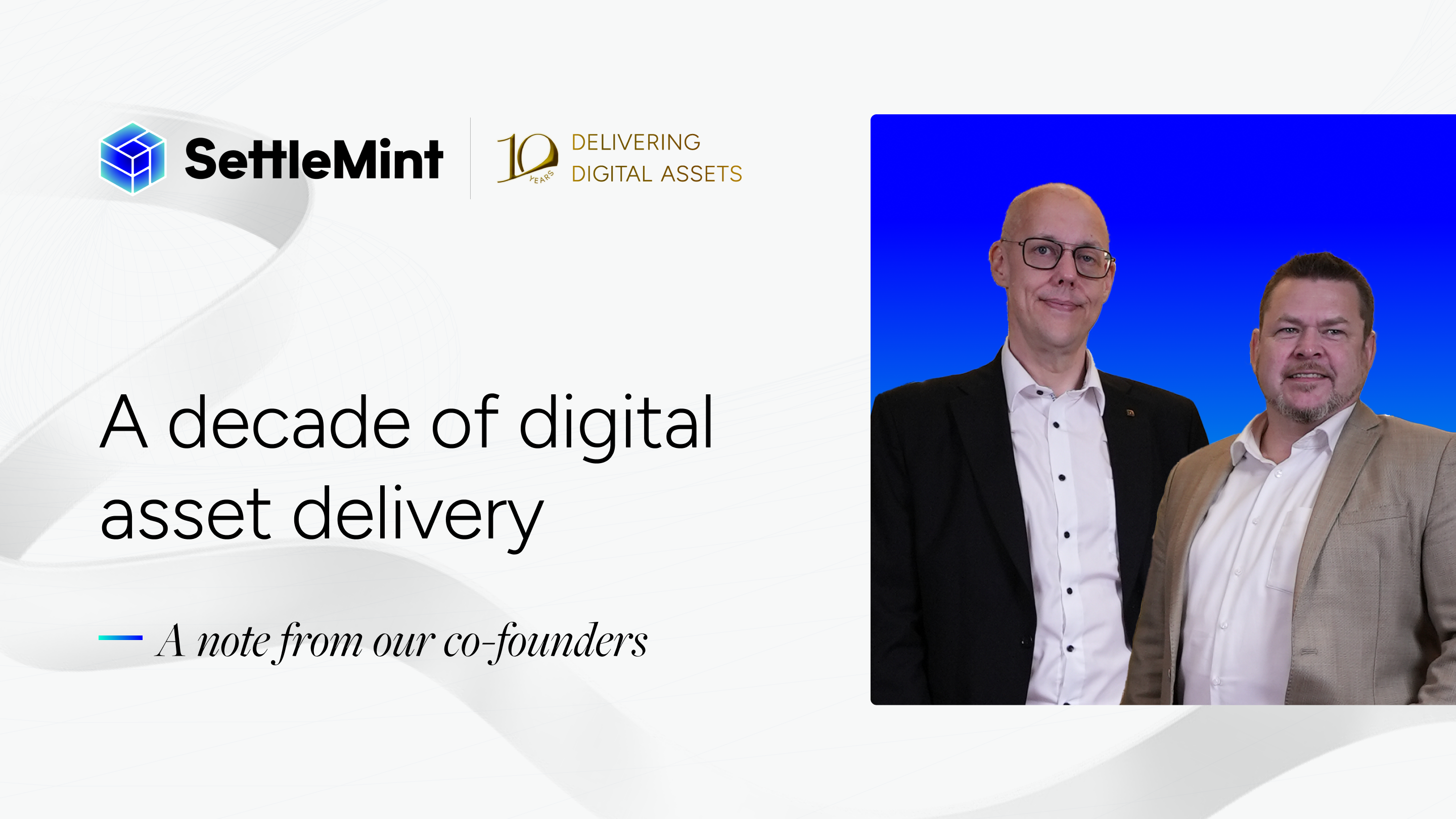
Matthew Van Niekerk & Roderik Van Der Veer
Co-founders, SettleMint
Ten years ago this week, the two of us started SettleMint to solve a challenge that sounded ambitious and fun at the time: bringing financial assets onto blockchain infrastructure inside regulated institutions. Ten years later, banks, market infrastructures and public registries have issued, held and transferred digital assets in production, some of them for years.
So the anniversary is a good moment to reflect on the next challenge. We do not have a crystal ball, but one thing we will say with confidence: in ten years, digital assets inside regulated institutions will look ordinary. Settlement gets shorter, ownership sits on a shared record, collateral moves with less friction, and servicing and reconciliation run continuously. Getting there will draw on three lessons the industry learned the hard way during its first decade, and we want to set them out here.
The first decade taught the industry what a real client requires
The past ten years was a long period of experimentation across the private and public sectors. Much of it served a purpose. It also left many institutions with unfinished programmes and an understandable scepticism toward anyone promising the next wave.
Those programmes failed in the gap between technical design and institutional reality, even when the underlying technology was ready.
Roderik puts it this way: "Every great architecture dies at first contact with a real client."
Security teams need to understand who can access what, and under which controls. Legal teams need clarity on ownership, transfer rights and exactly when settlement becomes final. Operations teams need to know how failures are handled when only part of a transaction completes. Audit needs to be able to reconstruct the decisions and actions behind a transaction months later.
If these challenges only arise towards the end of a programme, they can quickly become blockers and force significant changes to a design that may already have taken months to build. We brought those challenges into the process from the start. Rather than spend a year building in isolation, we built alongside innovation, technology, operations, compliance and business teams working against real constraints. That experience shaped the platform as our clients moved into production.
Ten years later, the result is the number Matthew cares about most: "Every client that went live with us is still live. We focused on the workflows that would satisfy compliance requirements in highly regulated jurisdictions, rather than on whether the platform itself could support the use case."
Ordinary means the whole lifecycle is supported, with the checks on-chain
That is also why we have moved beyond the language of "tokenization". It describes the first step, but very little of what comes after it.
Matthew's view: "If we keep calling this tokenization, we do not differentiate. The next decade is digital asset lifecycle management: issue, hold, transfer, service."
Lifecycle is where the complexity becomes real. Executing a transaction is only the beginning; once an asset moves into normal operations, the rules around ownership, eligibility, transfers and servicing need to move with it. Otherwise, compliance ends up being managed separately from the asset itself.
Roderik's rule is simple: "If it needs to be checked, it belongs on-chain. No reconciliation afterwards. If it is not correct, it did not happen."
The same standard applies to the interface an institution's own systems see. Any self-respecting financial institution will integrate the systems it already has, so the platform has to behave like infrastructure: "From an API I expect the call to run end to end. When the response comes back, it either happened or it did not." That is the difference between a demo and a production system, and it is the difference institutions now test for.
Ordinary means running where the bank runs, for as long as the bank runs
The third lesson is about where the software lives. A bank does not adopt a shared cloud because a vendor prefers one.
Roderik: "We built to run air-gapped, on-premise, from the beginning. I know that does not sound like blockchain. Banks have very valid reasons."
From there, the same platform runs through private clouds to public mainnets, and we expect hybrid to become the default: permissioned where the institution needs control, public networks where the market is.
Deployment is only part of the infrastructure test. The software also has to keep working as regulation, products and market structures change around it. Regulatory change is a constant in banking. Contracts need to evolve as rule sets change, while instruments and operating models differ from one institution to another. That is why the platform has to be composable rather than a longer list of toggles. That decade of upgrades has made us careful with the word "proven".
In Roderik's words: "We do not over-commit to the newest thing. These systems have to run for ten or twenty years. The hype cycle is faster than that. A lot of innovation is happening. Not a lot is production grade yet."
The next decade will be shaped inside institutions
To be clear, the technology is not what holds the market back now. The technical side is de-risked. Regulators are defining how digital assets fit within established legal frameworks, central banks are building settlement in central bank money, and we can see the transition across the Eurosystem's DLT settlement work, Singapore's Project Guardian and evolving frameworks in the US and Middle East.
What remains is organisational, and that effort is still underestimated. Banks are deciding which products justify investment and who owns digital assets internally, bringing Legal, Risk, Compliance, Operations and Technology in from the start. Their diligence will ask whether a provider can support production, satisfy security, audit and supervisory requirements, and stay viable at scale.
Matthew's answer to that diligence: "A standalone product story will not get this to ordinary use. The institution's own teams have to own it, and they need partners who stay in the stack."
We do not expect every market to arrive at the same architecture. National law, market structures and the role of banks differ too much for that. But we do expect some of those differences to narrow as regulation becomes clearer and institutions converge around common operating standards. Every implementation will still require choices about where trust, privacy and control sit, and which information and processes belong on-chain.
Ten years ago, institutions were beginning to put assets on-chain. The next ten years will bring digital assets into the systems banks use every day: API in, deterministic result out, on whatever network the institution is allowed to run.
We have spent a decade helping institutions get assets on-chain. We intend to spend the next one making them part of how banks operate.
Matthew van Niekerk
Roderik van der Veer